

Thirty-two years in, I can tell you the one skill that humbles every child in the room. Sharing. It comes before reading. Before counting. Before sitting still for an entire snack. We have been working on it since 1994, and the children have not solved it yet. Occasionally, neither have the parents at drop-off. (I said what I said.)
[Switches to serious face.] Social-emotional development is what happens before the academic work can land — a child who can't manage a feeling can't listen to a lesson, and a child who can't read the room can't make a friend. This covers what it actually includes, what to expect by age, why telling kids to share doesn't work, and what actually helps at home.
In this article
What Social-Emotional Learning Actually Includes
Researchers organize it into five domains. Most parents have heard of one or two without knowing the full picture.
- Self-awareness — knowing what you feel and why. A child saying "I'm frustrated" instead of just throwing the toy.
- Self-management — handling a feeling without it handling you. Taking a breath before hitting.
- Social awareness — reading the room. Understanding other people have perspectives different from your own.
- Relationship skills — building and maintaining connections. Listening, taking turns, asking before taking.
- Responsible decision-making — thinking through the consequences of a choice before making it.
None of that sounds complicated until you watch a two-year-old decide whether to hand over the red truck. Then it looks like philosophy. The National Association for the Education of Young Children treats it as foundational — not a soft add-on, but the soil everything else grows in.
Why the Early Years Matter Most
The Harvard Center on the Developing Child describes early childhood as a period of rapid neural development — roughly one million new connections per second. The architecture built in this window shapes how a child handles stress and reads relationships for life.
This isn't an argument for pressure, it's one for environment — children learn to regulate emotions around a calm, consistent adult who models it and lets them practice working things out. Thirty years in, the children who struggled most were rarely the ones who weren't "smart enough." They were the ones never allowed to feel a hard feeling and work through it. Neither fixing it for them nor telling them to stop feeling it builds the skill. The early years are the window. Not the only one. The most open.
What to Expect at Each Age
These are typical developmental patterns. Individual children vary. If something concerns you, talk to your pediatrician. This section is for calibration, not diagnosis.
1–2 Years: Parallel Play and Early Empathy
Children play near others, not with them — parallel play, and it's developmentally correct, not antisocial. It's observing, mirroring, occasionally testing what happens when you take their block. Early empathy shows up too: a one-year-old who offers their stuffed animal to a crying friend noticed the distress and tried to help. That's the seed of the whole thing.
2–3 Years: Naming Emotions and Tantrums as Communication
Children begin naming emotions here — "I'm mad," "I sad," "I scared." The vocabulary is limited but the recognition is real; encourage it every time. Tantrums peak in this window too, and they're communication, not manipulation — a two-year-old on the floor doesn't have the neurological equipment to "calm down on command." The job of the adult is co-regulation: stay close, stay calm, wait it out. Not reward it. Not punish it. Outlast it.
3–4 Years: Cooperative Play and Beginning Impulse Control
Children begin to play with each other, not just alongside — cooperative play requires negotiation: who's the doctor, whether the train goes on the blue track or red. Impulse control starts emerging too. A three-year-old who pauses before grabbing, even briefly, is showing real development. Recognize it: "I saw you wait your turn. That was hard."
4–5 Years: Perspective-Taking and Managing Disappointment
Theory of mind consolidates around age four — children start understanding other people have inner lives different from their own, which is when sharing becomes genuinely teachable. Managing disappointment — not getting the role in dramatic play, not winning the game, the tower falling over — is the social-emotional work of this age. More on how this connects to school in what kindergarten teachers actually look for.
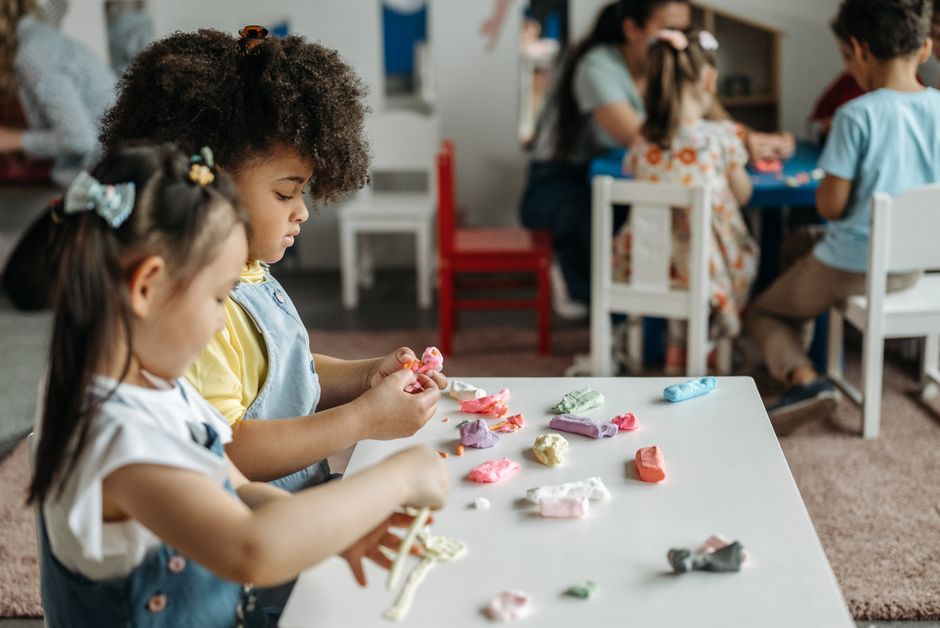
Why Young Children Cannot Just Share
Sharing requires theory of mind — a child has to understand the other child's wanting is real, and that giving something up serves something they value: fairness, connection, happiness. That's a demanding chain of reasoning, and it solidifies around age four. Before that, demanding a child share asks them to perform a task they haven't developed yet. What they learn instead is that adults escalate until they hand it over. That's compliance, not generosity — and it doesn't build any.
What works instead
Timed turns with a visual timer. Parallel setups with identical items. Describing what's happening — "She's waiting, she looks sad, what do you think she wants?" — builds the social awareness real sharing needs later. What doesn't work: "Be nice." It names a feeling, not a tool.
The research note: Zero to Three is explicit that forced sharing can slow the development of genuine prosocial behavior. Children who see adults model sharing without fanfare are more likely to choose it themselves. Generosity has to be chosen to become a value.
What Parents Can Do at Home
The most powerful social-emotional learning happens at home, not at daycare.
Name emotions as you see them
"You look frustrated. That block tower keeps falling." Not "don't be upset" — you're giving them the word for what they already feel. A vocabulary for emotions helps kids regulate better.
Model your own emotions out loud
"I'm really tired, so I need five minutes to sit quietly before I can help." Your child is watching you regulate. Or not. The modeling happens either way.
Separate the feeling from the behavior
The feeling is always allowed; the behavior is what you redirect. "You're angry. Hitting is not okay. Here's a pillow you can hit." Kids who learn feelings are shameful hide them instead of managing them.
Let them work conflicts out
Step in only when someone might get hurt. A four-year-old negotiating over a toy is doing the cognitive work they need — rescuing them robs them of the practice. Narrate from a distance ("you two are figuring that out") without solving it. More on our approach.

When This Program Is Not the Right Fit
Lisa's Rascals is a general-education licensed home daycare — some families need more support than that, and honesty serves them better than optimism.
When to look for a different program
- If your child has a diagnosis of a social communication disorder — including autism spectrum disorder — or is in intensive behavioral therapy, a program staffed with behavioral therapists will serve them better than we can.
- If your child requires a 1:1 aide or individualized behavioral support plan, the group structure here isn't built for that.
- If you want a formal social-skills curriculum with progress reporting, a larger center-based preschool will give you that. Our approach is naturalistic — through play, not a scripted lesson plan.
If none apply, call us to ask about availability or review the full program. More on school readiness at five.
Frequently Asked Questions
What are social-emotional skills in early childhood?
Social-emotional skills are the abilities children develop to manage their own feelings, build relationships, and navigate social situations. Researchers organize them into five domains: self-awareness, self-management, social awareness, relationship skills, and responsible decision-making. These develop gradually from infancy through the early school years, not on a fixed schedule.
Why can't toddlers share?
Because the cognitive ability to understand another person has a separate inner life — theory of mind — typically develops around age four. Before that, a child doesn't experience the other child's disappointment as real the way an adult does. Demanding a two-year-old share teaches compliance, not generosity. Timed turns and parallel play with identical toys work better at that age.
How do I help my toddler manage big emotions?
Name the emotion first — "You are angry" — before anything else. Redirect the behavior, don't deny the feeling: "Angry is okay. Hitting is not okay. Here's something to squeeze." Keep your own voice calm — children in distress regulate partly by mirroring the adult nearby. The goal at this age is co-regulation, not independence.
What is the difference between a tantrum and a meltdown?
A tantrum has an audience and a goal — the child knows you're there and is partly performing. A meltdown is a complete loss of regulation; the child isn't performing and isn't in control. Tantrums de-escalate when the audience leaves. Meltdowns require co-regulation: proximity, calm, time. Treating a meltdown like a tantrum often makes it longer and more intense.
When should I be concerned about my child's social development?
Key surveillance points: at 18 months, no pointing to share interest and no social referencing (checking your face for reactions). At 2 years, no two-word phrases and no pretend play. At 3 years, no interest in other children and no symbolic play. These aren't diagnoses — they're prompts to talk to your pediatrician. Earlier is better than wait-and-see.
