
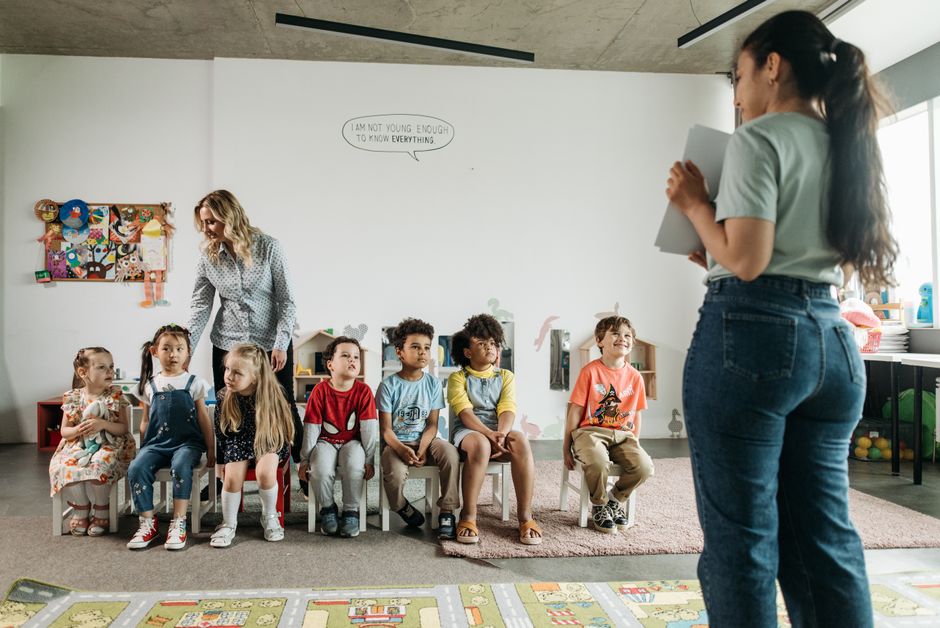
If play is the work of childhood — the American Academy of Pediatrics says it is — then my daycare room runs the most productive union shop in Laurel, Maryland. Zero coffee breaks. One labor dispute over the red crayon, unresolved.
The benefits of play-based learning, in short: stronger language and vocabulary, early math and problem-solving skills, social skills like turn-taking and conflict resolution, emotional regulation and executive function, physical coordination, creativity, and a lasting motivation to learn. Children build all seven through play before age six — not through worksheets, and not by accident.
In this article
What Play-Based Learning Actually Is
Play-based learning is not free time with toys scattered around. Children build skills through doing, not being told. It includes free play — child-initiated, no agenda — and guided play, where an adult designs the environment toward a skill the child never needs to know is the point.
A child sorting blocks by color is doing early math. A child negotiating who wears the firefighter hat is practicing conflict resolution — no worksheet required, just time, materials, and an adult who knows when to step back.
The Benefits of Play-Based Learning
The National Association for the Education of Young Children (NAEYC) points to play as the primary driver of healthy development before age six.
Language development
Vocabulary grows fastest during play. Children narrate, negotiate, and argue through an imaginary block city — more language work than a matching worksheet asks of them.
Early math and cognitive skills
The Education Endowment Foundation reviewed 66 studies and found guided play had a greater effect on early numeracy than direct instruction. Sorting, building, and predicting are all mathematics — they just do not look like it to a four-year-old.
Social skills
Cooperative play requires role assignment, turn-taking, and reading social cues with real stakes attached. A child who also wants the blue block teaches sharing better than any worksheet about it.
Emotional regulation and executive function
This is the one that matters most at kindergarten entry. The Harvard Center on the Developing Child documents it clearly: executive function — attention, impulse control, working memory — develops through child-directed play, not instruction. Struggling kindergartners are usually behind on turn-taking, not letters.
Physical development
Fine and gross motor skills develop through physical play. Cutting playdough builds the hand strength needed for a pencil grip. Climbing builds balance — a prerequisite for what follows.
Creativity and problem-solving
Open-ended materials force the brain to generate solutions instead of reproducing them. A toy that does one thing trains recognition. A block that can be anything trains divergent thinking.
A genuine motivation to learn
Children raised in play-based environments approach new material with curiosity instead of performance anxiety. Academic drilling before six produces short-term letter-recognition gains that level out by second grade. Curiosity built through play does not.
The counterintuitive finding: academic preschoolers score higher on letter recognition at age four. Play-based preschoolers score higher on reading comprehension, math, and social skills by age ten. Skills built through play compound; skills built through drilling plateau.
Free Play vs. Guided Play — The Difference Matters
Parents sometimes ask whether children just do whatever they want all day. The answer is no, and also yes.
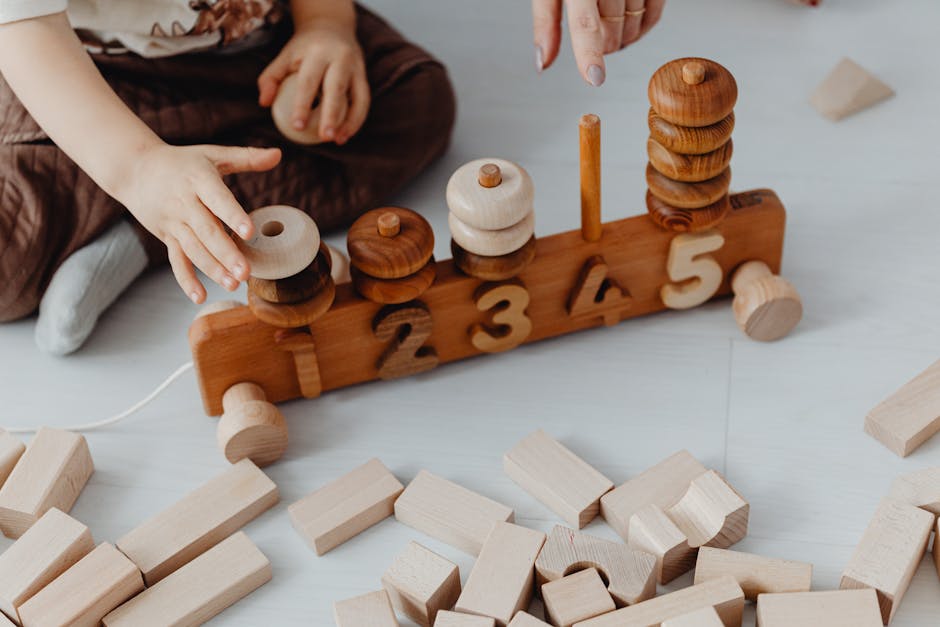
Free play is unstructured time where the child decides everything — what, where, how long. Guided play is when an adult arranges the environment: materials placed on purpose, a question asked at the edge of a child's thinking. The child never needs to know they are being guided.
The adult's job here is not passive supervision. It takes judgment to know when a question extends a child's thinking and when it interrupts work already underway — judgment that takes years, and does not happen in a room where keeping the peace is the main job.
The Honest Downsides of Play-Based Learning
Play-based learning has real trade-offs. There are no tests or grades, so tracking where a child stands takes a caregiver who is actually paying attention. Some children — especially those who like clear rules — settle into open-ended time more slowly than a worksheet routine. And a program leaning entirely on free play, with no guided component, can leave real gaps in letters, numbers, and science.
None of that argues against play-based learning. It argues for a program with an adult who is actually watching.
How to Tell If a Program's Play-Based Learning Is Real
"Play-based" appears on nearly every daycare website in Prince George's County. Here is how to tell whether a program means it.
Look at the schedule. Fifteen-minute segments with constant transitions never let a child reach the deep-play state where the real work happens. That takes at least 20 to 30 unbroken minutes.
Ask about staff turnover. Guided play only works when an adult knows a child well enough to introduce the right material at the right moment. Average turnover at U.S. childcare centers runs 26–40 percent a year (Child Care Aware of America, 2023). A caregiver who leaves before learning a child's edge cannot do the guided half of guided play.
Look at the children at pickup. The compliment I hear most, across more than fifty families over thirty-two years, is not that a child was learning. It is that they did not want to go home.

How to Support Play-Based Learning at Home
You do not need educational toys. You need time, space, and the restraint not to run the show.
- Open-ended materials: blocks, cardboard, paint, water. The less a toy does on its own, the more a child's brain has to.
- Twenty unbroken minutes of play beats an hour of five-minute bursts.
- Sit nearby and observe instead of directing.
- Ask "what are you making?" instead of "is that a house?"
- Follow their lead — it develops further than what you'd suggest.
The hardest part is trusting it is working when it does not look like work. See how the programs at Lisa's Rascals apply this, or come for a free 30-minute tour.
When Lisa's Rascals Isn't the Right Fit
Play-based learning suits most children under six. It is not the right choice for every family's priorities.
When to look elsewhere
- Formal academic instruction, structured worksheets, and performance tracking before age five — a Montessori or structured pre-K program aligns better. We do not do worksheets here.
- Specialized therapeutic support — speech, occupational, or ABA therapy — as the primary component of the day, which a licensed therapeutic setting serves better.
- Care for more than eight children, or hours beyond Monday–Friday, 7 AM–6 PM. Maryland caps family childcare at eight — that is why the ratio works, but it makes this a small program, and small is not right for every family.
For a typical day, the about page covers the program's history since 1994. To see the room, a free visit is the fastest way to decide. On kindergarten readiness specifically, see what kindergarten teachers actually look for.
Frequently Asked Questions
What is play-based learning?
An approach where children build skills through play rather than direct instruction. It includes free play (child-initiated, open-ended) and guided play (adult-designed, aimed at a goal the child doesn't need to know about). NAEYC and the American Academy of Pediatrics both call it the primary driver of healthy development before age six.
What are the benefits of play-based learning?
Language, early math and problem-solving skills, social skills, emotional regulation and executive function, physical coordination, creativity, and a lasting motivation to learn — all seven develop through play in ways direct instruction before age six does not reliably replicate.
What are the disadvantages of play-based learning?
Without tests or grades, tracking where a child stands takes a caregiver who is actually paying attention. Some children settle into open-ended time more slowly than a structured routine. A program with no guided component can leave gaps in letters, numbers, and early science.
Is play-based learning better than worksheets for preschoolers?
For children under six, yes — particularly for the skills that matter at school entry. Academic drilling before six produces short-term letter and number recognition gains that level out by second grade. The Education Endowment Foundation reviewed 66 studies and found guided play had a greater effect on early numeracy than direct instruction.
What is the difference between free play and guided play?
Free play is entirely child-initiated, with no objective. Guided play is when an adult designs the environment or introduces materials to invite exploration toward a goal, without directing the play itself. Both are part of genuine play-based learning; neither alone is enough.
How can I support play-based learning at home?
Open-ended materials — blocks, art supplies, cardboard, water, containers. At least 20 minutes of uninterrupted play daily. Observe rather than direct. Ask open-ended questions. Expensive educational toys are not required. Unbroken time is.
